

How To Calculate Field Goal Distance
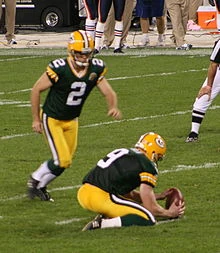
Every identify kicker has his own comfortable field goal range.
Field goal range is the part of the field in American football where at that place is a adept chance that a field goal endeavor will be successful.
A field goal is normally 17 yards (7 yards in Canadian football game) longer than the altitude of the line of scrimmage to the goal line, as information technology includes the cease zone (10 yards) and seven yards in which the holder stands behind. In Canadian football, the goal posts are on the goal lines, in front of the end zones. Therefore, if the line of scrimmage is at the 30, the field goal would be 47 yards (in American football) or 37 yards (in Canadian football).
Average field goal range
The exact field goal range varies for each team, depending on the ability of the team'south placekicker.[1] While some weaker placekickers may have trouble kicking field goals longer than 40 yards (making field goals from beyond the 23 difficult), others may consistently make 50-yarders, making information technology practical to boot from across the 33. For most NFL kickers, the 35-yard line is typically the limit of their field goal range.[2] Weather conditions, particularly wind, as well have a pregnant bear upon on field goal range; kicking with the wind at the kicker's back significantly increases field goal range, while kick against the wind or with a stiff crosswind will profoundly reduce the kicker'due south constructive range, while generally in that location is no reward across assured targeting of a kick if a game is being played indoors. Altitude as well has an impact on boot range; both the longest punt in NFL history and two of the longest field goals in NFL history took identify in Denver, Colorado, which is more than than 4,000 anxiety (1,200 m) higher in pinnacle than the next-highest NFL metropolis (the Phoenix suburb of Glendale, Arizona).
In high schoolhouse football game, players are permitted to boot off special flat kicking tees upward to two inches loftier. The NCAA banned the use of kicking tees in 1989. Most of the longer-range field goals in NCAA history were kicked prior to the emptying of tees; the use of tees allowed the ball to be elevated out of the field's grass or turf, reducing friction in the opening milliseconds of the kick and allowing for longer kicks.
Kicking versus punting
If a kicker is outside of field goal range, teams will generally punt. Nonetheless, punting too close to the end zone increases the risk of a touchback, which nullifies nearly of the effect of the punt. Thus, teams who confront a fourth down between the 35 and twoscore thou lines (closer in a crosswind) oft will become for the more risky fourth down conversion rather than take chances either the touchback or the missed field goal.[ citation needed ]
Record holders
The longest field goal in recorded football history was 69 yards, set by Swedish kicker Ove Johansson in 1976. The longest successful field goal in the NFL regular flavour is 63 yards, and has been achieved iv times - snapped from the defending squad's 46-yard line in 3 instances (Jason Elam, Sebastian Janikowski and David Akers), as well every bit from the kicking team's ain 45 yard line [run into: http://www.youtube.com/picket?v=hu73YSmtiXU, 47 seconds into the video] (Tom Dempsey), because goal posts were placed at the goal line up until 1974. The NCAA record is 67 yards held by iii kickers, Russell Erxleben of Texas, Steve Little of Arkansas and Joe Williams of Wichita Land Academy. All three of those kickers achieved that feat in the 1977-1978 college seasons. Notably, Johansson, Erxleben and Petty all failed dramatically when they entered the NFL— Johansson'due south failure was due to an injury, only the other two were highly drafted busts.
The CFL record is 62 yards held by Paul McCallum, the NFL preseason record 65 yards held by Ola Kimrin, the contained amateur record (too as the record without the aid of a tee; tees are not allowed in the NFL and have been banned from NCAA since 1989) is 68 yards held past Fabrizio Scaccia, and the high schoolhouse record 68 yards held by Dirk Borgognone; high school has wider goal posts and treats a field goal attempt that lands short in the field of play the same as a punt, making longer attempts much less risky. The indoor football record, with narrower and higher goal posts, is 63 yards (set by Aaron Mills), which is practically every bit long of a field goal as is possible in that variant of the sport, since the field in indoor football (including both end zones) is only 66 yards. Scaccia, while playing indoor football, attempted a 64-g kick that was inches short of success, hitting the crossbar. Longer field goals have been attempted at times; the longest attempt in the NFL, which was well short and was kicked into the wind, was 76 yards, attempted by Sebastian Janikowski.
NFL Europe rewarded kickers that successfully kicked a field goal of longer than l yards with a bonus signal, making such field goals worth 4 points instead of iii; this rule has since been adopted by the Stars Football game League.
The shortest possible field goal under current strategies is slightly over 17 yards in American football and 8 yards in Canadian football (Canadian football requires the ball to be snapped at to the lowest degree one thousand away from the end zone). Theoretically, a field goal could exist attempted from a shorter altitude equally long equally the holder stays behind the line of scrimmage (or, in Canadian football, via a drop kick at any indicate on the field), just in do this has never happened.
Drop kicks
It has been surmised that a drop kick has a slightly longer range than the standard place kicking, just since these kicks are so rare, that is not known for sure. During the early on NFL era, this was generally truthful, and driblet kicks were the norm for longer field goals; in fact, the kickoff unofficial NFL tape boot of 55 yards, prepare by Paddy Driscoll in 1924, was indeed set by drop boot.
The only successful driblet kicking in the NFL since the 1941 NFL Title game was past Doug Flutie, the backup quarterback of the New England Patriots, against the Miami Dolphins on January i, 2006, for an actress point later a touchdown. Flutie had estimated "an fourscore percent chance" of making the drop kick, which was chosen to give Flutie, 43 at the fourth dimension, the opportunity to make a historic kick in his terminal NFL game, the drop kick existence his final play in the NFL. After the game, New England coach Bill Belichick said, "I think Doug deserves it," and Flutie said, "I just thanked him for the opportunity." The boot was executed from 27 yards out (Flutie stood in a punter position, 15 yards behind the line of scrimmage). Drew Brees, a former teammate of Flutie'due south, attempted a drop-kicked extra indicate from the same position during the poorly-received 2012 Pro Bowl; his kick, however, cruel short.
References
- ↑ "Fantasy Football For Dummies - Martin Signore - Google Boeken". Books.google.com. http://books.google.com/books?id=4WSF_v7OYbAC&pg=PT116&dq=%22field+goal+range%22&lr=&as_brr=3&ie=ISO-8859-1&output=html . Retrieved 2012-eleven-23.
- ↑ "The Complete Idiot'due south Guide to Football, 2nd Edition - Joe Theismann, Brian Tarcy, Brian Tarcy - Google Boeken". Books.google.com. http://books.google.com/books?id=UbZ0LSlfXXYC&pg=PA33&dq=%22field+goal+range%22&as_brr=3&ie=ISO-8859-1&output=html . Retrieved 2012-11-23.
| Gridiron football concepts | ||||||||||||
|---|---|---|---|---|---|---|---|---|---|---|---|---|
| Codes |
| |||||||||||
| Levels of play |
| |||||||||||
| Field |
| |||||||||||
| Equipment |
| |||||||||||
| Positions |
| |||||||||||
| Play types |
| |||||||||||
| Scoring |
| |||||||||||
| Penalties |
| |||||||||||
| Turnovers |
| |||||||||||
| Downs |
| |||||||||||
| Play clock |
| |||||||||||
| Statistics |
| |||||||||||
| Celebrations |
| |||||||||||
| Officiating |
| |||||||||||
| Miscellaneous |
| |||||||||||
Source: https://americanfootballdatabase.fandom.com/wiki/Field_goal_range
0 Response to "How To Calculate Field Goal Distance"
Post a Comment